The International Monetary Fund’s annual review mission projected on November 18 that the United Arab Emirates would grow by 0.2% in 2026, rather than shrink by 3.9% as the IMF had forecast a month earlier. Its projection of 7.3% growth in 2027 came with a condition: it assumes “the regional disruptions are lifted.”
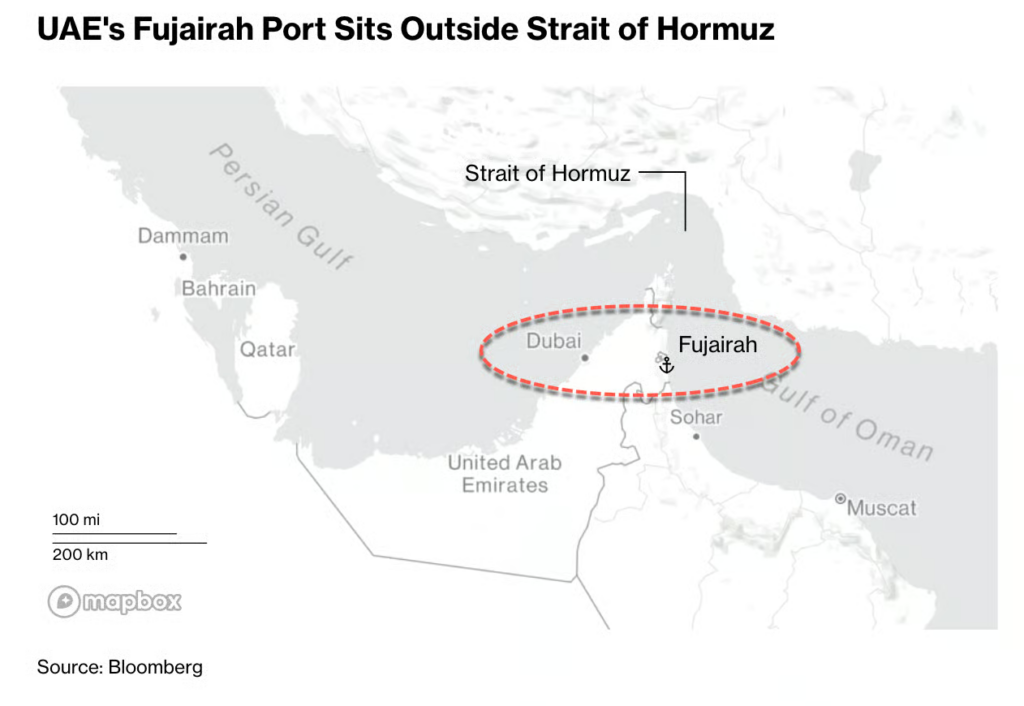
The Strait of Hormuz shows why that condition matters. Oil production recovered after a steep fall in March, helped by a pipeline that reaches the port of Fujairah without passing through the strait. But the pipeline cannot carry all the oil the UAE aims to produce, and shipping traffic through Hormuz in early November was still about 65% below its level before the war with Iran began on February 28.
Different growth rates, nearly identical output
The World Bank’s October outlook projected a deeper setback and a faster recovery than the IMF’s November review. Yet the two forecasts imply nearly the same level of real GDP, or output adjusted for inflation, in 2027.
| Forecast | 2026 real GDP growth | 2027 real GDP growth | 2027 output (2025 = 100) |
|---|---|---|---|
| World Bank, October 2026 | −1.6% | 9.5% | 107.75 |
| IMF mission, November 2026 | 0.2% | 7.3% | 107.51 |
The World Bank’s 9.5% rebound starts from a lower base. Although its 2027 growth rate is 2.2 percentage points higher than the IMF’s, the difference in projected output is only about a quarter of a percentage point of 2025 GDP. Both forecasts assume regional conditions improve.
A comparison with the prewar trend puts that recovery in perspective. According to the World Bank, the UAE grew by 4.3% in 2023, 6.6% in 2024 and 6.2% in 2025. Two more years at roughly that average pace would have put output 11.7% above its 2025 level, against 7.5% under the IMF projection. Using the UAE’s 2025 GDP of $614 billion, that gap is about $26 billion in 2025 prices. It is a comparison with a continuation of past growth, not a measure of confirmed war losses.
The limits of the Fujairah bypass
The World Bank reported that UAE oil output fell from 3.4 million barrels a day before the war to 1.9 million in March, then recovered to 3.8 million by June. Rerouting, better shipping conditions and greater production flexibility after the UAE left OPEC on May 1 helped the recovery. Non-oil trade rose 13.1% in the first half of 2026, while non-oil exports rose 23.9%.
The Habshan–Fujairah pipeline can carry about 1.8 million barrels a day. The World Bank noted plans to double that capacity, but even 3.6 million barrels a day would be well short of the UAE’s production capacity target of 5 million barrels a day by 2027. The expansion is planned capacity, not an export route already available to producers.
UK Maritime Trade Operations recorded 308 vessel crossings through Hormuz in the week ending November 11. Insurance costs also pointed to continued disruption: an S&P Global report cited by Al Jazeera put war-risk premiums at 7.5% to 10% of a ship’s hull value, up from 1% to 3% previously.
Hotels and equities tell different parts of the story
Tourism contributed about $70 billion, nearly 12% of UAE GDP, in 2025. Dubai hotel occupancy fell to 68.4% in October 2026 from 84.9% a year earlier, according to CoStar’s STR. Economy and Tourism Minister Abdulla bin Touq Al Marri later told CNBC that occupancy was returning to “almost near normal” and that he was “very optimistic” about UAE growth of 7% to 8% in 2027. His assessment was more recent than the October hotel figures, but it did not provide a comparable occupancy rate.
Emirati stocks had already recovered their prewar price level by one measure. The US-listed iShares MSCI UAE ETF closed at $21.64 on November 24, up 1.4% from $21.35 on February 27, according to iFind Flow closing prices. The fund is not a proxy for the whole economy: its ten largest holdings accounted for 74% of the portfolio, according to holdings compiled by Composer. Banks made up about a third and property companies about 17%, while much of the disruption to airlines, airports and hotels fell outside the index.
The fund price therefore says less about whether trade and travel are returning to normal than vessel crossings, insurance premiums and hotel occupancy do. Those measures distinguish what the UAE has already achieved by rerouting trade from what the IMF’s 2027 forecast still assumes: relief from the disruption itself.