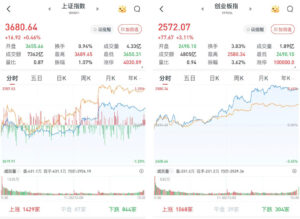
After months of volatility in China’s A-share market, conditions are in place for a rebound, according to Chen Guo, deputy director of research and chief strategy officer at East Money Securities. In an interview reported by The Paper on November 10, 2026, Chen said market-stabilization measures had eased concerns that falling prices and weakening liquidity could reinforce each other.
Chen attributed part of the earlier decline to crowded trading and high expectations for AI commercialization and capital spending. Those expectations have since been revised down, he said, while inflows into broad-market exchange-traded funds and measures to support financial-market liquidity have helped steady sentiment. In his view, some sectors that had fallen sharply are beginning to recover as investors return to pricing shares on fundamentals.
A rebound would not necessarily be smooth. Chen said risk appetite remained subdued after several months of market swings, and a substantial near-term improvement in company fundamentals could take time. He saw a broadly favorable environment through year-end and into early 2027, but said investors might take profits after an initial rebound, potentially increasing disagreement in December. His expectation of a choppy upward trend depends in part on domestic and overseas conditions remaining relatively stable.
Chen said the market would increasingly focus on economic and industry fundamentals as short-term liquidity concerns recede. Among the factors he identified were oil prices, overseas interest rates, Chinese domestic demand and policy expectations. He also said growth in overseas AI infrastructure and China’s related exports was likely to slow next year, making a recovery in domestic demand more important to watch.
On market positioning, Chen favored a balanced, or “barbell,” approach rather than relying on a single theme. He said dividend-paying shares and stable-growth blue chips could serve as a core holding, alongside more volatile opportunities in AI applications, emerging growth areas and industries where conditions might improve. These were Chen’s views on market allocation, not a forecast that any particular sector will rise.
Chen urged investors to distinguish AI’s long-term industrial prospects from expectations for capital spending and share prices. He said US AI capital-expenditure growth might slow in 2027 and 2028, though stronger commercial returns could change that outlook. He argued that evidence of practical, revenue-generating AI applications would be important to sustaining expectations for further spending on AI hardware and infrastructure.
Source: m.thepaper.cn (originally published 2026-11-10 17:19 UTC+8)