Sandisk shares fell 16.05% to $79.24 on November 20, 2026, a day after research firm TrendForce brought forward its forecast for a decline in NAND flash memory prices. The selloff came three weeks after Sandisk reported record quarterly results. The question for investors was how much of that profit the company could retain if memory prices fell.
November 20 was the first trading session after an eight-for-one stock split, but the split did not account for the decline. Sandisk’s November 19 close of $755.16 was equivalent to $94.39 on a split-adjusted basis. The November 20 loss brought the stock’s weekly decline to 28.4%. On November 24, shares fell 11.1% to $77.95 amid a broader selloff in AI infrastructure stocks. The Nasdaq fell 5.3% that day, and memory chipmaker Micron lost 13%.
Why pricing matters to Sandisk’s earnings
Sandisk’s September-quarter revenue rose 378% from a year earlier and 23% from the preceding quarter to $11.03 billion. Its non-GAAP gross margin reached 85.1%, and GAAP net income was $8.1 billion. Management forecast revenue of $12.2 billion to $12.6 billion for the following quarter.
Sandisk sells NAND flash, the storage memory used in phones, laptops and data-center drives. Revenue depends on both the number of bits sold and the price per bit. Higher prices accounted for most of the annual revenue increase, but some of Sandisk’s largest costs do not fall when prices do. According to company filings summarized by Lightyear, Sandisk gets substantially all its wafers from joint ventures with Kioxia and must pay half the ventures’ fixed costs even if it buys less output.
On November 19, TrendForce forecast that NAND contract prices would be flat to 5% lower in the first quarter of 2027, with declines across all product categories starting in the second quarter. That was an earlier and broader downturn than it had projected in July. Spot prices, which can signal a change ahead of contract negotiations, had already fallen more than 20%, even as TrendForce still expected contract prices to rise 8% to 13% in the final quarter of 2026.
Contracts protect some sales as industry supply grows
Sandisk’s data-center revenue reached $4.8 billion in the September quarter, up 61% from the preceding quarter and 1,685% from a year earlier. Eight long-term customer agreements, including deals with three large U.S. cloud providers, cover about half of fiscal 2027 bit volume and two-thirds of fiscal 2028 volume. According to Sandisk’s chief financial officer, the agreements start with fixed prices and then move to floors and caps. The floors are designed to secure an annual gross margin of at least 80% on covered sales, not across the company.
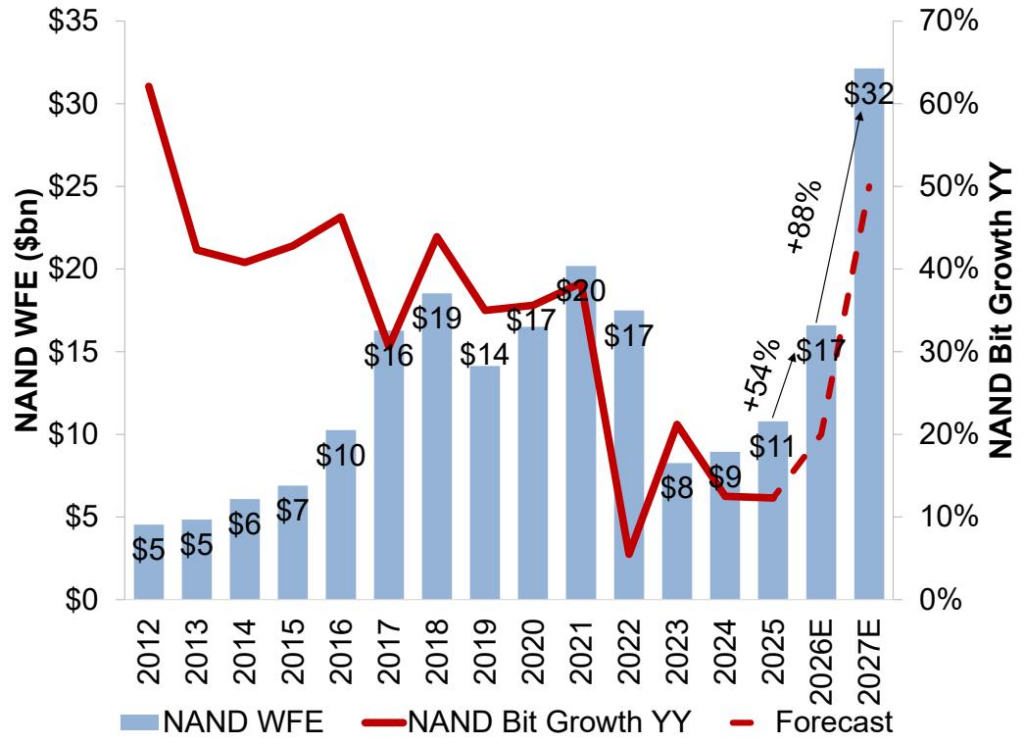
Demand outside those agreements was uneven. Sandisk’s consumer revenue fell 29% from the preceding quarter and 39% from a year earlier. TrendForce said Chinese cloud providers had cut their 2027 solid-state-drive orders by more than U.S. providers had added. Meanwhile, the research firm expected industry bit supply to grow 25% to 30% in 2027 as manufacturers increased capital spending and shifted to denser chips.
At the November 24 close, Sandisk traded at about five times its split-adjusted non-GAAP earnings of $14.81 per share over the previous four quarters. That multiple measures the price against profits earned during a sharp rise in NAND prices. The contracts could slow the effect of a downturn on reported earnings, but roughly half of fiscal 2027 volume remains exposed to market pricing. How far contract prices fall, rather than the spot decline alone, will help determine how much of the September quarter’s margin Sandisk can sustain.