
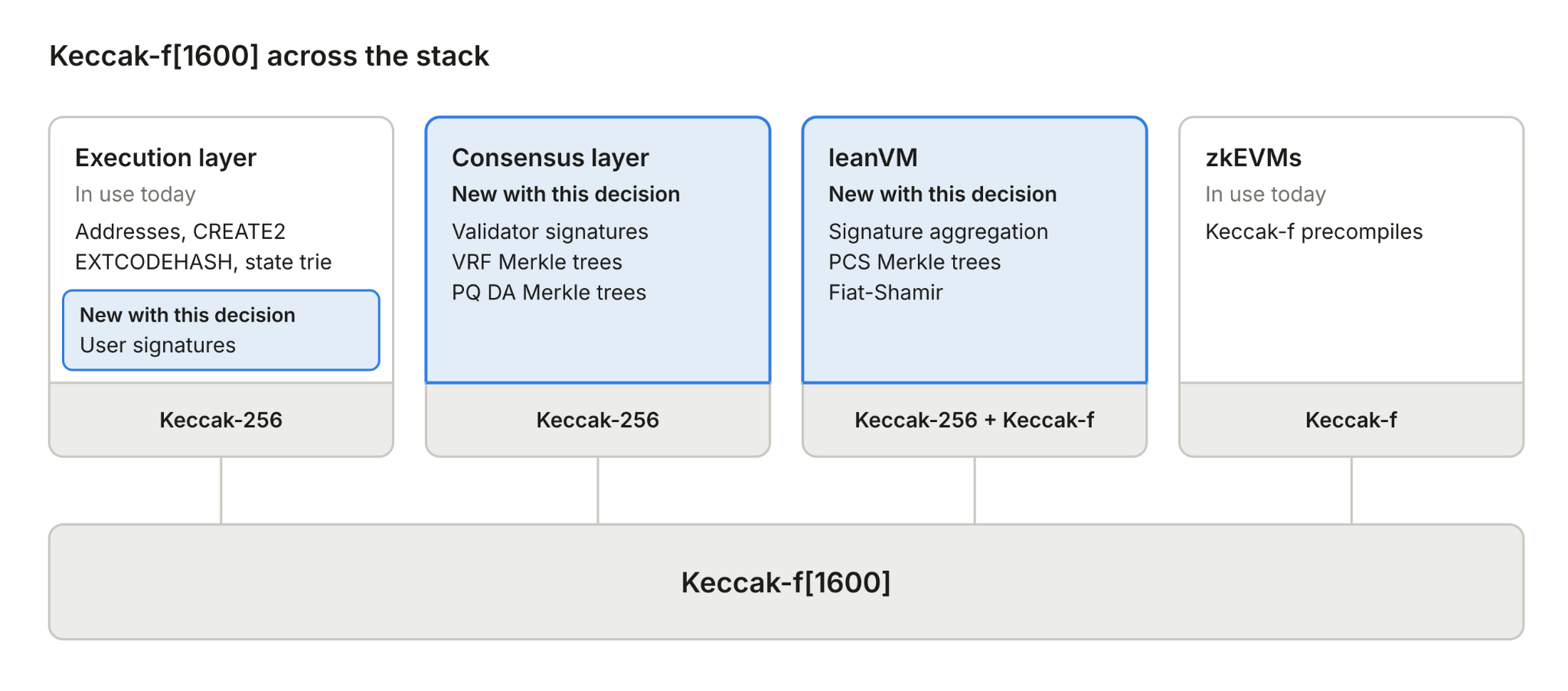
The Ethereum Foundation recommended Keccak-256 on Nov. 24, 2026, as a building block for signatures designed to withstand quantum computing. Ethereum already uses the hash function for addresses and for tracking the network’s state. The recommendation does not change how validators sign blocks or how users authorize transactions: developers have yet to choose a replacement signature scheme or set a date to switch.
The scale of that decision is visible in the staking figures. A Nov. 24 query of public beacon-chain data counted 770,781 active validators holding 44.37 million ETH, roughly 36% of the circulating supply. At that day’s ETH price of $1,671.61, according to Ainvest data, the stake was worth about $74 billion. A migration would require validators to change signing keys while the network continues to operate.
Why the Foundation favors Keccak
A hash produces a fixed-size fingerprint of data. A signature proves control of a private key. Ethereum validators use a signature scheme called BLS, while ordinary accounts use ECDSA. A sufficiently powerful, fault-tolerant quantum computer could forge either kind of signature. That would require a different class of machine from today’s noisy quantum devices; the Foundation’s case for starting now rests partly on how long a migration will take.
Until recently, researchers favored Poseidon because it was less costly to use inside the proofs Ethereum plans to use to aggregate validator votes. Newer proof systems can meet or exceed Ethereum’s target of about 500,000 hashes per second for standard hashes. That gave the Foundation room to favor Keccak’s nearly two decades of security analysis over faster alternatives. The full version of Poseidon has not been broken.
AI also figures in the Foundation’s reasoning. In its research series, Kev Wedderburn argued that AI models are finding software flaws faster than people can review them and that cryptographic algorithms should not be assumed immune to similar scrutiny. According to the Foundation, AI-assisted analysis has not so far weakened Keccak’s security. That is an argument for its choice of hash, not evidence that AI has broken Ethereum’s current signatures.
The choice of signature scheme remains separate. ETH Daily reported that the main contenders were ML-DSA, a lattice-based standard, and leanSPHINCS, a hash-based alternative. The Foundation’s post strengthens the performance case for the hash-based approach but does not name leanSPHINCS or select it.
Who bears the cost
The Foundation has doubled its protocol security team, but much of the implementation falls to others. Client developers must deliver compatible software, staking operators must rotate keys, and wallet providers must give users a workable way to migrate accounts. Rollup teams face a related change to the cryptographic commitments used for data they post to Ethereum. The security benefit would extend to all users, while the engineering work falls on a smaller set of teams.
The choice also matters for operating costs. Hash-based signatures are larger and slower than BLS signatures. The Foundation says developers will need to monitor bandwidth, storage and hardware requirements so that people can still run nodes at home. If those costs rise too far, professional staking pools could gain an advantage.
One trade-off is already visible: research group Ethlabs withdrew its Quick Slots proposal from the planned Hegotá upgrade to free engineering time. Other delays have separate causes. Developers postponed the Glamsterdam upgrade’s Hoodi testnet activation on Oct. 22 because of interactions between EIP-8037 and existing contracts, before the Foundation published its Keccak recommendation.
There is no agreed migration deadline. Ethlabs has argued for 2027, Justin Drake floated December 2028, and the Foundation has an internal deadline of 2029, with a timeline review planned for January 2027. For ETH holders and staking providers, the next material decisions are which signatures the network will use and what it will take to deploy them. The hash recommendation settles neither question.