Decrypt published Tyler Warner’s Morning Minute on November 10, 2026. The session it described was not a rally. Warner’s news line said crypto majors were continuing to slide, with bitcoin flat at $74,200. In the market snapshot, majors were red by about 1–2%. Bitcoin was even at $74,200. Ethereum was down 1% at $2,100. Solana was down 1% at $84.7. Zcash was down 4% at $1,150. HYPE was up 1% at $73.60. Stable (+8%), JUP (+7%), and PYTH (+3%) led the top alt movers he listed.
The argument that led the newsletter was a valuation pitch, not a flow print. Warner reported that Vitalik Buterin had spent Sunday on X telling Ethereum holders to stop valuing ETH as a fee-burning token and to start valuing it as a store of value.
The pitch, and the issuance math behind it
Buterin wrote: “We should not feel sad if fee burn is less than 10% of breakeven indefinitely.” He added: “The value of ETH comes from elsewhere.” Warner identified that elsewhere as stability, tied to decentralization, censorship resistance, and security.
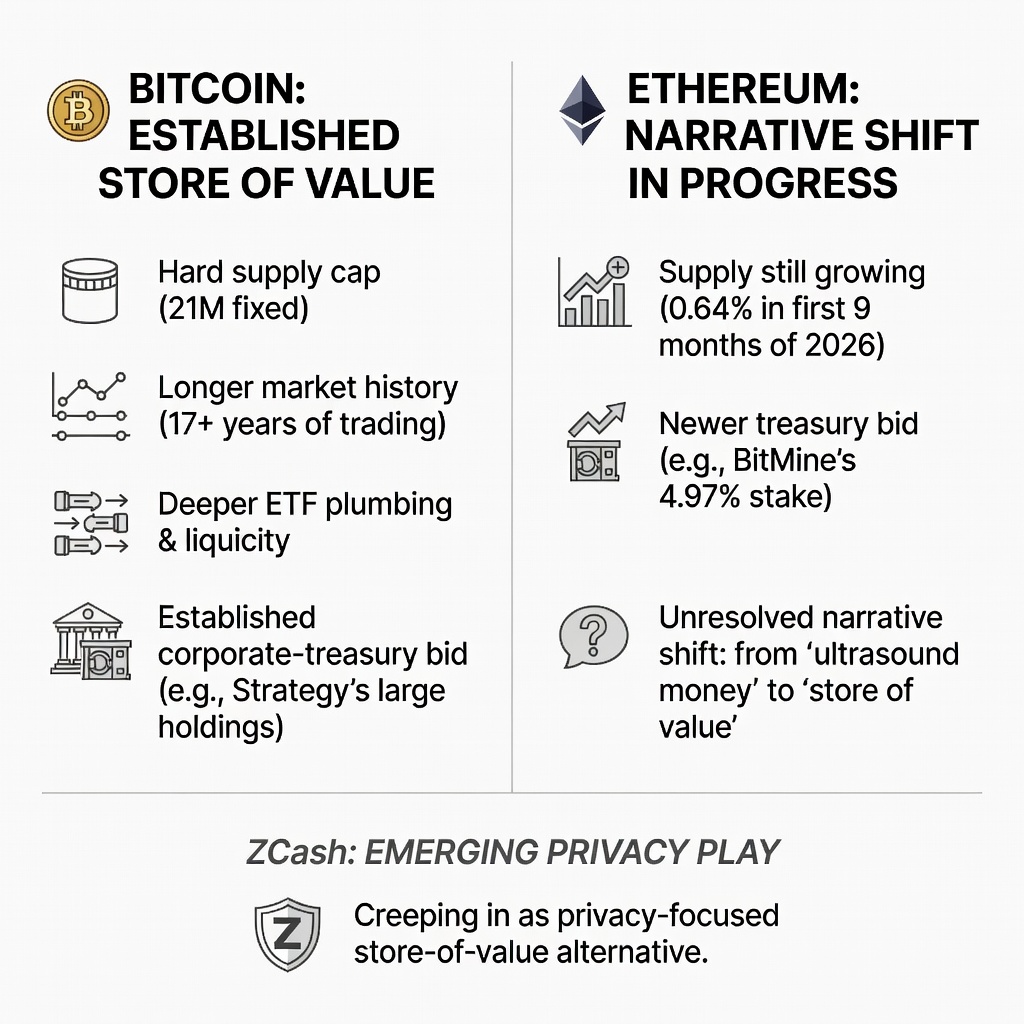
The pitch replaces “ultrasound money,” the idea that usage would burn supply faster than staking created it. Warner wrote that the burn had not kept up in years. Through the first nine months of 2026, burn offset about 2% of issuance while supply grew 0.64%, mostly because Ethereum’s rollup roadmap had moved activity and fees off mainnet. That “mostly because” is the newsletter’s explanation of the supply math. It is not a claim, in the piece, that the roadmap caused that day’s prices.
Buterin’s argument, as Warner relayed it, was that the weaker burn was acceptable and that chasing fee revenue would be worse. Maximizing fees means wanting congestion and expensive blockspace. Buterin warned that would turn Ethereum into “a world-scale major corporation” at the cost of what makes it worth using. The burn, he added, was “never a true floor” and came mostly from internal crypto churn such as lending and “silly NFT purchases.”
ETH in the same snapshot was down 1% at $2,100. The newsletter does not connect that print to the Sunday posts.
A store-of-value comparison, with the gaps named
Warner wrote that supporters were already building the new frame. Ethlabs co-founder Binji Pande called ETH a future-proof store of value and argued it beats Bitcoin on quantum and AI risk. He cited eleven years of trading history and an Ethereum Foundation holding under 0.2% of supply. Julian Ma of Ethlabs made a related case: that Ethereum’s security culture positions it as a programmable store of value as AI pressures cryptography. Those are advocates’ arguments. The newsletter does not present them as demonstrated.
Warner’s objection was that store of value is Bitcoin’s category. Bitcoin, he wrote, holds it with a hard cap, more Lindy, deeper ETF plumbing, and a corporate-treasury bid ETH was only starting to build. Zcash, he added, was creeping in as the privacy store-of-value play. ETH had not historically been considered a store-of-value play. “It remains to be seen,” he wrote, whether Buterin could make the pitch stick.
The likeness is only that both assets were being described as something to hold beyond fee income. The differences are the ones Warner listed. Bitcoin’s supply is capped; the 2026 figures he cited still had ether supply growing. Bitcoin’s ETF and treasury channels were described as deeper; ether’s corporate bid was described as early. A rhetorical category change is not the same event as a change in flows.
What the money was doing
The listed flows do not show a surge of ETF demand in that window.
Bitcoin ETFs saw $201 million in net outflows on Monday. ETH ETFs saw $185 million in outflows. Warner’s top line said bitcoin ETF outflows were continuing and were now more than $2 billion over the past seven sessions. That seven-session figure is a longer clock than Sunday’s posts or Monday’s session. The piece supplies no leverage or liquidation totals, so a forced-unwind story cannot be read out of it. Outflows also do not establish a cycle top or a cycle bottom.
Treasuries were mixed. Buyers and sellers in the same issue should not be collapsed into one bid.
Lookonchain, as cited by Warner, counted fourteen public companies selling roughly 108,247 BTC, worth $8.08 billion, so far in 2026. MARA at 40,581 coins and Riot at 20,264 accounted for 56% of that total. In the same issue, Strategy bought 1,036 BTC for $81.9 million at an average of $79,012 and repurchased $188.3 million of its STRC preferred. Both were funded by a $283.8 million sale of MSTR common stock. The stated average, $79,012, is above the $74,200 spot level in the same newsletter. The piece does not say those trades and that spot print were simultaneous.
BitMine added 9,587 ETH, worth about $20 million, lifting its treasury to 6,070,092 ETH, or 4.97% of supply. Chairman Tom Lee called Buterin’s comments “a seismic shift” that validates the strategy. That sentence is Lee’s reading of remarks that line up with a treasury BitMine already reported. It is not a market-wide confirmation.
BlackRock said demand from large holders converting self-custodied bitcoin into IBIT shares was “the highest we’ve seen at any point,” citing security concerns, with roughly $3.6 billion of such swaps since the SEC permitted in-kind transactions. The newsletter’s news line called the same story record demand for in-kind BTC redemption for IBIT. The $3.6 billion is the cumulative swap figure tied to BlackRock’s comment, not the Monday net flow. On Monday, bitcoin ETFs were still in net outflow, by $201 million.
Adoption headlines in a red session
Coinbase had received final OCC approval for a national trust charter. Warner wrote that the approval moved its institutional custody business under federal oversight, and that Coinbase was joining Circle and Ripple, which won approvals in July and October. He did not state the year of those earlier approvals.
Ava Labs said Avalanche would serve as the core ledger for the clearing firm behind the NYSE’s forthcoming tokenized-securities platform, with round-the-clock clearing and settlement across equities listed on several chains. Formation Securities had notified the SEC that it intends to run a tokenized-securities venue on Solana under the agency’s Innovation Exemption, launching in early 2027. Those are stated plans and a charter. They are not measured trading volume, and the newsletter does not claim they lifted prices. Majors were down.
The same snapshot had oil down 2% at $85 and gold down 1% at $4,085. Stock futures were mixed ahead of CPI: the Dow up 0.4%, the Nasdaq down 0.3%. Sharing a morning with the crypto tape is not evidence that CPI expectations caused the 1–2% crypto slide. Warner does not draw that link.
Where the analogy stops
Keep the clocks separate. Sunday is the dating the newsletter gives Buterin’s posts. Monday is the dating it gives the $201 million bitcoin ETF outflow and the $185 million ETH ETF outflow. The seven-session outflow above $2 billion is wider than either. The year-to-date 2026 supply math, the public-company bitcoin sales, and BlackRock’s roughly $3.6 billion of in-kind swaps are wider still. Stacking them does not make the posts the cause of the flows, or the flows a verdict on the posts.
A store-of-value pitch can sit beside ETF outflows, large listed-company bitcoin sales, and a small ether treasury purchase. Warner’s limit, in that November 10, 2026 newsletter, was explicit: it remained to be seen whether the pitch would hold. The prices in the issue did not settle it.
Morning Minute is Warner’s newsletter. Decrypt noted that the analysis and opinions are his and do not necessarily reflect Decrypt’s.
Original article: Morning Minute: Vitalik Recasts ETH as a Store of Value (Decrypt, November 10, 2026).