The question raised by AI’s investment boom is not whether the technology will prove useful. It is whether every project being built can earn enough to repay the money financing it. That was the focus of a November 24, 2026, report comparing today’s data-centre build-out with the dot-com era.
The report cites Federal Reserve figures showing that advanced-computing-related debt issuance exceeded $680 billion in the first ten months of 2026, compared with $130 billion in all of 2023. Outstanding public debt tied to advanced computing exceeded $1.1 trillion—roughly 13% of the $8.6 trillion investment-grade corporate bond market measured in the second quarter. The sharper concentration is in new borrowing: the report says the sector accounted for nearly a third of non-financial investment-grade corporate bond issuance in 2026 to that point.
Large technology companies can fund much of their construction from operating cash flow. But some projects also rely on joint ventures, leases and debt markets. The report points to Meta’s $50 billion Hyperion data-centre project in Louisiana, financed through a venture owned 80% by Blue Owl and 20% by Meta, as one example.
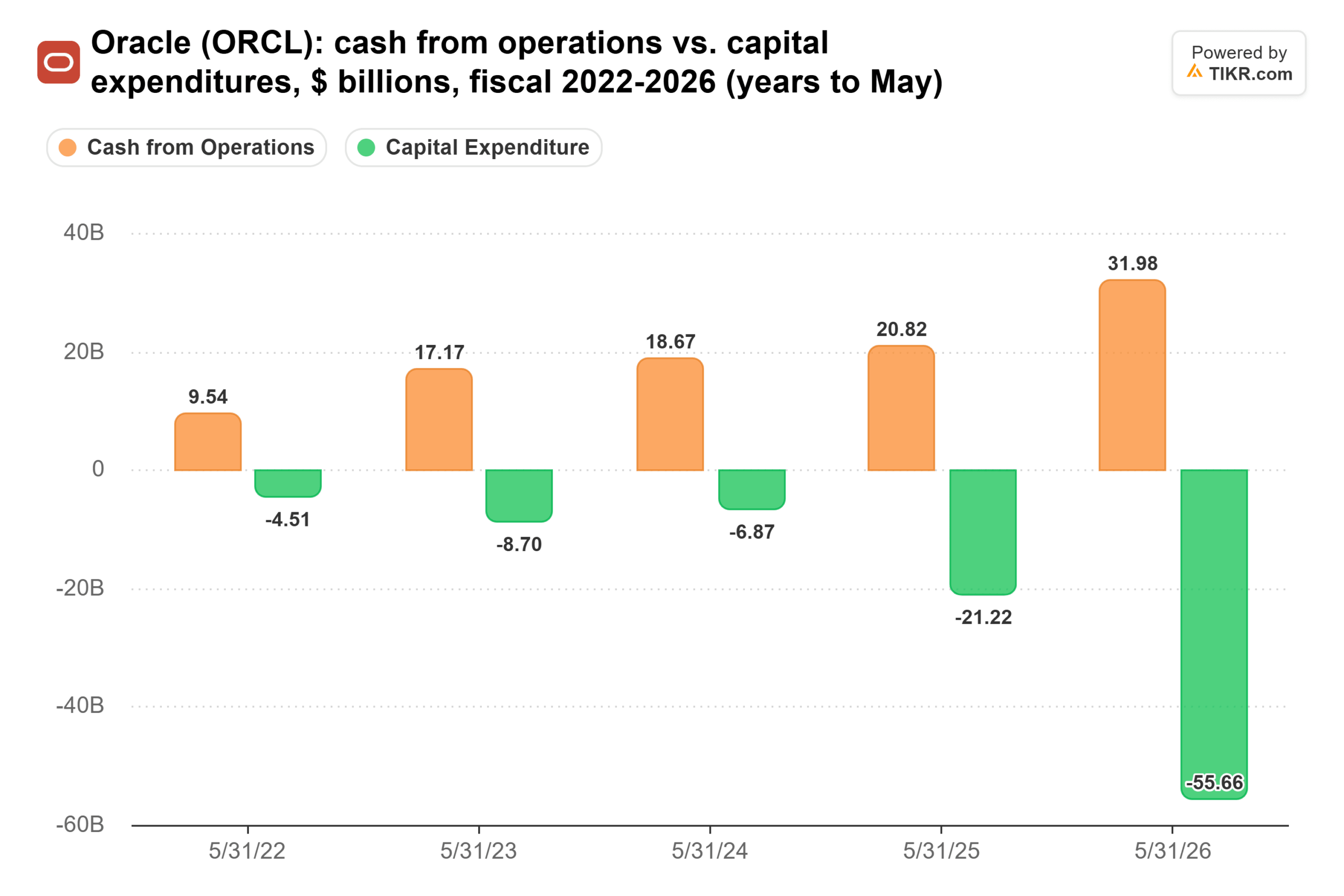
Oracle illustrates the pressure capital spending can put on cash flow. According to the report, its total debt rose from $75.9 billion in fiscal 2022 to $167 billion in fiscal 2026. It spent $55.7 billion on capital projects in fiscal 2026 and reported negative free cash flow of $23.7 billion. Its fiscal filing also reported $67.4 billion in revenue and $664 billion in remaining performance obligations, or contracted work not yet billed. S&P estimates that OpenAI accounts for about half that backlog.
That customer exposure is central to the comparison. The report puts OpenAI-related commitments recorded by Oracle, Microsoft, Amazon and CoreWeave at roughly $740 billion in total. Separately, the Financial Times reported that OpenAI told investors its annualised revenue was approaching $50 billion at the end of September. Commitments and annualised revenue are different measures, but the gap makes customers’ ability to keep funding future demand consequential for suppliers.
A dot-com-style collapse is not inevitable. Federal Reserve governor Michael Barr said on November 16 that he was less concerned about direct losses because of the still-limited debt backing the boom. He identified circular financing and residual-value guarantees as possible channels through which a repricing could spread.
The distinction is between assets that may remain valuable and the returns expected by those financing them. Data centres could be built and used even if some investors or lenders lose money. Whether the more heavily financed projects can refinance their debt as planned remains the test.