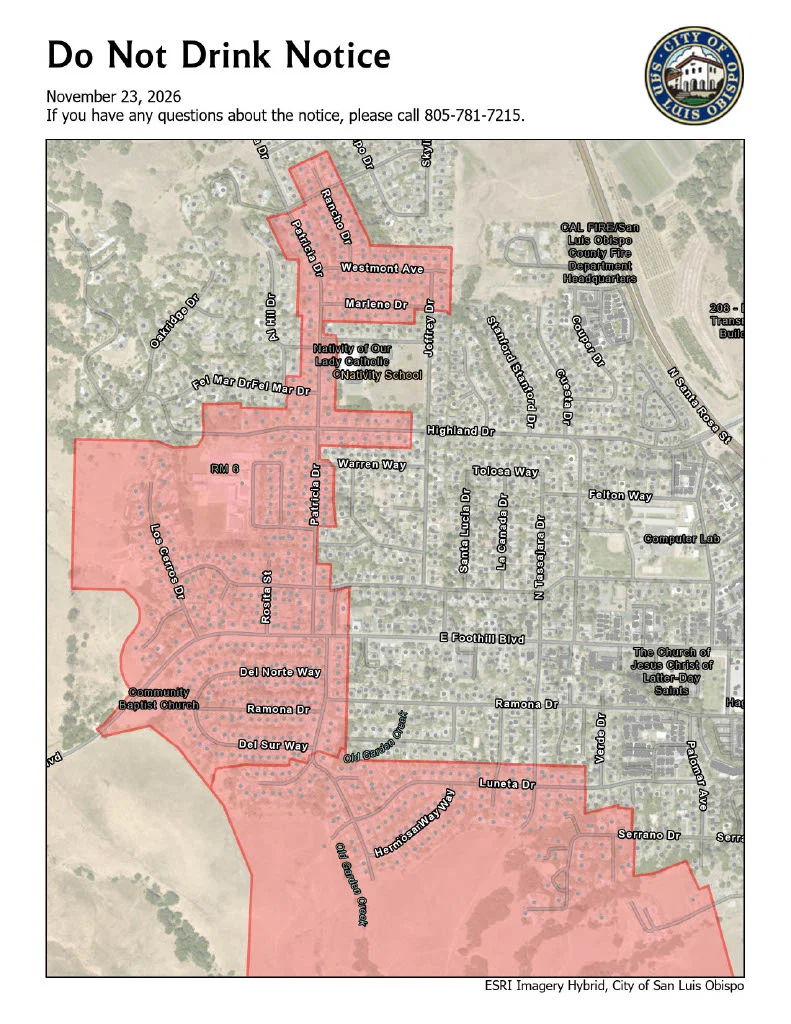
At 3:30 on Monday, Nov. 23, an alarm on a drinking-water tank in San Luis Obispo, California, went off when the hatch on top was lifted. By Monday morning, 516 homes in the Serrano and Patricia neighborhoods had been told not to drink, cook with, brush their teeth with, or make ice from the tap. The city’s warning included a detail that separates a security scare from a routine boil-water notice: do not boil it, either. Boiling kills bacteria. It does not remove an unknown chemical. The city drained the tank, flushed the lines, sent samples for expedited testing, and made bottled water available at Bishop Peak Elementary School. As of Monday afternoon, the notice was still in effect, and the city had not confirmed that anyone had put anything into the water. The alarm did its job. The question for an investor is who gets paid for the next one.
The city’s map shows how precisely the notice was drawn: a defined neighborhood, a few hundred homes, not a citywide emergency. That precision matters for the public-health response. It also matters for the investment question, because a problem this contained is easy to mistake for a business opportunity.
A 516-home notice is not an earnings event
Start with scale. American Water Works, the largest regulated U.S. water utility, serves about 14 million people across 14 states. In October 2024, it found unauthorized activity in its information-technology networks. The company disconnected systems, notified law enforcement, and later told investors the incident “did not have a material effect” on its financial condition or results of operations. None of its water or wastewater facilities were affected. That was a real intrusion at a company serving 14 million people. If a major cyber incident at the largest player was immaterial to its financials, a precautionary notice covering 516 homes is not a stock catalyst. That does not make it unimportant. It makes it a window into how the water business is financed.
The same problem, two different balance sheets
San Luis Obispo’s water system is city-owned. When the tank alarm went off, the city spent money: staff time, bottled water, flushing, lab tests, and the water lost. Those costs land on the utility’s budget and, eventually, on ratepayers or taxpayers. There is no shareholder return built into the rate to reward the spending. The reward is avoiding a public-health disaster.
California Water Service Group, a listed utility whose California subsidiary is regulated by the state’s Public Utilities Commission, runs the other model. In the first nine months of 2026 it invested $425 million in infrastructure. Management projects rate base – the approved value of the assets it uses to serve customers – to grow nearly 12% a year, to about $3.5 billion by the end of 2028, assuming it completes its capital plan. The California regulator currently allows Cal Water a 10.27% return on equity, set through 2027, on a capital structure that is 53.4% equity. The overall authorized return on its rate base is 7.46%. That difference is the whole game. A city utility treats a tank upgrade as a cost to be minimized or financed. An investor-owned utility treats an approved tank upgrade as rate base: the company spends the money, the regulator adds the asset to the base, and the company earns a set return on it. Growth comes from putting more capital to work, not from charging more for the same gallon.
American Water’s recent rate orders show the range. New Jersey allows a 9.50% return on equity on a $6.1 billion rate base; Pennsylvania allows 9.55% on $6.6 billion; West Virginia allows 9.80% on about $1.1 billion. Those returns are not windfalls. They are the price regulators pay to get private capital to fund pipes, tanks, and treatment plants that a city might otherwise defer.
Why a city defers and a utility invests
The municipal model is not irrational. City utilities can issue tax-exempt debt and receive grants, and they do not have to earn a shareholder return. San Luis Obispo’s response was fast and competent. The alarm, the notice, the flushing, and the bottled water all happened within hours. But the city still has to raise rates or cut something else to pay for the next upgrade, and both are political decisions. That is the constraint that binds.
The Environmental Protection Agency’s 2023 drinking-water needs survey put the 20-year national investment need at $625 billion. A city can finance its share, but every project competes with schools, police, and everything else in the budget. An investor-owned utility faces its own constraint: the regulator. The company can propose a rate case, but the commission decides which costs are recoverable and what return is fair. The model converts infrastructure spending into earnings only after that approval. When the regulator delays or disallows, the spending becomes a cost again.
The consolidation trade is the real catalyst
This is why the deal that matters most for this question is not a security company. It is the merger of American Water and Essential Utilities, announced in October 2025. Essential serves about 5.5 million people across nine states and plans to invest $1.7 billion in infrastructure in 2026. Since 2015, it has acquired about $570 million of rate base and added more than 138,000 customers through acquisitions; it says its pipeline of potential municipal water and wastewater acquisitions represents about 400,000 customers. American Water added about 81,000 customer connections through acquisitions in the first nine months of 2026, including the Nexus Water systems. The two companies have received merger approvals from Kentucky, Ohio, and Virginia, reached settlements in Pennsylvania, North Carolina, and Texas, and expect to close in the first quarter of 2027. A simple sum of the two disclosed population figures would be about 19.5 million people, before any divestitures regulators require. The strategic logic is scale: one procurement organization, one security program, one balance sheet. A city utility cannot spread a security program across 14 million customers; a combined American Water and Essential can. That is the consolidation case.
What the share price is actually buying
The risk is that investors treat the rate-base model as a bond substitute. It is not. The allowed return is on the utility’s book equity, not on the price you pay for the shares. If the stock trades above book value, the buyer’s effective return on that allowed profit is lower than the headline ROE. And the headline ROE is set by a regulator, not by the market. The cost of capital has also moved. The 10-year Treasury yield was 4.92% on Nov. 20, 2026, according to the St. Louis Fed’s FRED database. A 9.5% allowed return on equity is about 4.6 percentage points above that. The spread is compensation for equity risk, and it is earned on book equity, not on the market price. The equity is only about half the capital structure, and the company must issue debt and shares to fund growth. Cal Water raised $49.8 million through its at-the-market equity program in the third quarter and signed agreements for $125 million of unsecured debt and $150 million of mortgage bonds. American Water’s interest expense rose $32 million year to date as it funded its capital plan. The operating numbers show the same tension. Cal Water’s third-quarter revenue rose 6.7% to $332.2 million, but earnings per share rose only two cents, to $1.05, as operating expenses and share issuance absorbed part of the growth. That is what regulated growth looks like: visible, capital-intensive, and sensitive to the spread between the allowed return and the cost of funding it.
The headline will fade; the rate case won’t
The city expects to resolve the notice within 72 hours. The tests will decide. If they are clean, the city will lift the notice. The event will remain a useful test of the model: a physical alarm caught a possible intrusion, a city responded quickly, and the cost landed on a municipal budget. The investment conclusion is narrower than the headline. This is a public-health story, a governance story, and a reminder of how essential infrastructure is financed. It is not a reason to buy a water-security stock. The spending is embedded in utilities’ capital budgets and equipment makers’ broader product lines; it is not a separate revenue stream an outside investor can underwrite. It is not a reason to sell a water utility, because 516 homes do not move a rate base. It is a reason to understand what you own if you own one. You own a regulated claim on a growing asset base, with its return set by a commission and its growth financed in the bond and equity markets. The next tank alarm will make the headline. The next rate case will decide what the headline is worth.