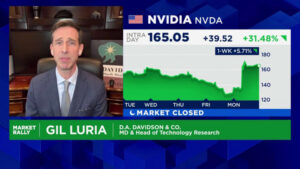
Zeta Global (NYSE: ZETA) closed at $32.43 on Monday, Nov. 23, 2026, up 9.9%. The gain came with a broad rally: the Nasdaq Composite rose 6.5% that day, and Nvidia jumped 31% after its board reinstated Jensen Huang as chief executive, according to closing data reported by FinanceFeeds. Zeta’s move tracked the market more than a fresh company announcement. The comments that frame the longer-term target were made a week earlier.
At a conference on Nov. 18, chief financial officer Chris Greiner repeated Zeta’s plan to reach at least $2.3 billion of annual revenue by 2028, with an adjusted EBITDA margin of at least 25% and free-cash-flow conversion of at least 65%, meaning free cash flow equal to at least 65% of adjusted EBITDA. Write-ups of that appearance said organic growth is accelerating. Third-quarter organic growth did accelerate. Measured against revenue Zeta has already guided for 2026, and against what Wall Street already expects for 2027, the same $2.3 billion figure implies much slower growth from here: about 11% a year from 2026, and roughly 5% in 2028 on top of the Street’s 2027 revenue estimate.
What the company sells
Zeta runs a data cloud covering more than 245 million U.S. adults and software that large brands use to find, keep, and sell more to customers across digital channels. Customers often start with pilots of $50,000 to $150,000 and can grow into “super-scaled” accounts spending more than $1 million a year. The company ended the third quarter with 212 of those accounts, up 18% from a year earlier, and average revenue per super-scaled customer of $2.0 million, up 22%.
Third quarter and the raised 2026 guide
The third quarter, reported on Nov. 9, 2026, was strong on the company’s published figures.
- Revenue was $492.7 million, up 46% from a year earlier and about $22 million above the midpoint of guidance.
- Non-GAAP earnings were $0.38 a share, against a $0.28 consensus estimate, a 36% beat.
- Organic growth was 30%, excluding the Marigold acquisition and political-candidate revenue, up from 28% in the second quarter and about 27% in the first.
- Adjusted EBITDA, profit before interest, taxes, depreciation, and amortization, was $121.0 million, a 24.6% margin, up 140 basis points from a year earlier.
- GAAP net income was $38.3 million, or $0.14 a diluted share, compared with a small loss a year earlier.
- Free cash flow was $81.5 million, up 73%.
Zeta also raised full-year 2026 guidance to $1.853 billion–$1.857 billion of revenue, up 42%, adjusted EBITDA of $414 million–$415 million, and free cash flow of $270.6 million–$271.6 million. By the company’s own count, it was the 21st consecutive quarter in which it beat expectations and raised guidance.
What is inside the 46% growth rate
Two items in quarterly revenue are not organic. Marigold’s enterprise business, bought for up to $325 million and closed on Nov. 24, 2025, contributed $48.0 million. Political-candidate revenue added $7.4 million. Together that is $55.4 million, or 11% of the quarter. The company states the split explicitly. Fourth-quarter guidance already shows a slower underlying pace: revenue of $521 million–$525 million, up 32%–33% overall but only 22%–24% excluding acquisitions and political-candidate revenue. That is below the 30% organic growth reported for the third quarter. The acceleration is a third-quarter result, not what the fourth-quarter guide describes.
Zeta also cites a “Rule of 71,” revenue growth plus adjusted EBITDA margin. At 46% growth and a 24.6% margin, the sum clears 71. On organic growth, the same math is 30 plus 24.6, or about 55. That is still a solid result by software standards, but it is a different claim from the headline version.
That does not make the growth fictitious. Super-scaled customers grew 18%, against the company’s own 4%–8% model, and revenue per super-scaled customer rose 22%, against a 12%–16% range. The headline rate still overstates underlying growth, and company guidance has that underlying rate lower in the fourth quarter.
Why the 2028 target looks undemanding
Zeta raised its 2028 revenue target to at least $2.3 billion in February 2026, from $2.1 billion, describing it as a 23% compound annual growth rate from 2024 to 2028. Revenue was $1.01 billion in 2024, so that long-range arithmetic held when it was set. The target was also written against 2026 guidance of $1.755 billion at the time, which implied about 14.5% annual growth in 2027 and 2028.
Since then, 2026 guidance has been raised twice, to $1.855 billion, up 5.7%. The 2028 target did not move. From that base, $2.3 billion in 2028 implies 11.3% annual growth over the next two years, compared with 30% organic growth in the latest quarter. S&P Global data put the Street’s 2027 revenue estimate at $2.19 billion, so clearing $2.3 billion in 2028 would require about 5% growth that year.
Greiner has described marketing spend by existing customers as more than $100 billion. Against that figure, $2.3 billion is about a 2.3% share. He said Zeta has about 2% today and could conservatively serve 15% to 20%. Those are management statements about opportunity, not delivered results.
Pay design points the same way. The 2026 performance award granted in March pays out against revenue targets from $2.0 billion to $3.0 billion, measured through 2030. That range brackets the public 2028 target and tops out 30% above it.
On those figures, the 2028 number works less as a stretch forecast than as a floor the company could clear without keeping recent growth rates. One cautious reading is that management sees a sharp slowdown ahead. The alternative reading, which this assessment treats as more likely given the record, is that the public target is stale and will be raised: the prior $1 billion target was hit a year early, and 2026 guidance has gone up twice. Either reading makes $2.3 billion a weak figure to use as the main anchor for the stock.
What the Nov. 23 price implies
The multiples below use the Nov. 23 close and 255.5 million shares outstanding as of Nov. 2. Market value is $8.29 billion. After $340 million of cash and $244 million of debt, enterprise value is $8.19 billion.
| Metric | On 2026 guidance | On 2028 target |
|---|---|---|
| EV / revenue | 4.4x | 3.6x |
| EV / adjusted EBITDA | 19.7x | 14.3x |
| EV / free cash flow | 30.2x | 22.1x |
At about 30 times this year’s guided free cash flow, the shares are not cheap on that measure. If Zeta hits the 2028 targets and the stock still trades at 22 times that year’s free cash flow, two years of growth would produce roughly no gain from the Nov. 23 price. At 27 times, described as a modest re-rating, the implied return is about 10% a year. On that arithmetic, the market is already paying for the target to be beaten.
How that compares with peers
Trailing figures as of the same close:
| Company | EV / sales | Revenue growth | FCF margin |
|---|---|---|---|
| Zeta Global | 4.8x | 41.0% | 13.7% |
| Braze | 5.8x | 27.4% | 9.6% |
| Klaviyo | 4.0x | 27.0% | 14.6% |
| HubSpot | 2.3x | 20.1% | 18.4% |
| The Trade Desk | 1.7x | 7.0% | 27.9% |
| Peer average | 3.5x | 20.4% | 17.6% |
Zeta trades at a 39% premium to that peer average on sales, while its revenue growth rate is roughly double the average. Dividing enterprise value to sales by the growth rate, Zeta is cheaper on that comparison than every peer in the set except HubSpot. Using the 30% organic rate instead, it sits between Klaviyo and Braze. The set also shows how slower ad-tech growth has been priced: The Trade Desk, with a 28% free-cash-flow margin, trades at 1.7 times sales with revenue growth of 7%. The Nov. 23 price looks consistent with the recent trend and full relative to the published 2028 plan. That is not described here as a bubble, and it is also not treated as a wide margin of safety.
Stock pay and shares outstanding
Free cash flow as Zeta reports it excludes stock-based compensation. That cost was $50.0 million in the third quarter, more than the $45.9 million of GAAP operating income. For the first nine months, stock-based compensation was $155.1 million against $44.0 million of operating income. As a share of revenue it is smaller than a year earlier: 14.7% in the first nine months of 2025 and 11.6% in the first nine months of 2026. The company is also buying back stock, with $85.5 million of repurchases and tax withholding in the first nine months and $78.5 million left on a $200 million program.
The share count still rose, from 244.8 million at Dec. 31, 2025, to 255.5 million at Nov. 2, 2026, an increase of 4.4%, including 3.9 million shares issued to Marigold’s sellers. Free cash flow per share is therefore growing more slowly than the dollar total. On company guidance, 2026 free cash flow of about $271 million is about $1.06 a share, versus $0.67 in 2025, up 58%, against 65% growth in the dollar amount. The cash generation is not in dispute; the relevant figure for a shareholder is the per-share amount.
Risks that remain in the numbers
Political revenue can distort the base. 2026 is a midterm year, and candidate spending lands mostly in the fourth quarter. The amount is small, $7.4 million in the third quarter, but 2027 has no federal election, so later growth will be measured against revenue that will not repeat.
The data model is a risk the company flags itself. Its position rests in part on a cloud of more than 245 million profiles built partly on consented web tracking, as Greiner described at the conference. Browsers, regulators, and app stores have repeatedly changed those rules, and Zeta’s 10-Q lists data collection and privacy rules among its principal risks.
Reported growth also depends partly on acquisitions. Growth of 46% versus organic growth of 30% is the difference made by purchased revenue. Marigold cost up to $325 million and came with cash, stock, and a seller note. More deals would mean more integration work and the possibility of further dilution.
Analyst opinion is one-sided. Of 15 analysts, 11 rate Zeta a strong buy and two a buy; none rate it a sell. The average target is $40.14, about 24% above the Nov. 23 close. With almost no public dissent, the room for surprise is skewed toward disappointment rather than a further positive shock.
Where that leaves the valuation
The operating record is stronger than it was two years earlier: the company is GAAP profitable, generating cash, growing organically near 30%, and taking more spending from its largest customers. The $2.3 billion target does not describe that pace. Raised 2026 guidance has already made the target easy to clear.
At 4.4 times forward sales and about 30 times forward free cash flow, with organic growth guided to 22%–24% in the current quarter and political revenue set to roll off in 2027, the Nov. 23 price already reflects a good outcome. The resulting stance is a hold, on the view that a further beat is already being paid for.
The levels cited for a change in that view are a price near $26, roughly 20 times an estimate of about $320 million of 2027 free cash flow, or evidence in the first half of 2027 that organic growth is holding above 25% without political revenue. The level cited for turning negative is organic growth below 20% while the stock still trades above 4 times sales. Short of one of those, the 2028 target is a figure to watch rather than a reason to chase the shares.
Prices and valuation multiples above are as of the Nov. 23, 2026 close.