December COMEX gold futures traded near $3,651 an ounce shortly before 2 p.m. ET on Monday, Nov. 23, 2026, up 3.8% on the day. The rebound followed a sharp decline: gold had closed the previous Friday at $3,515.40 after touching $3,502.90, its lowest level since August 2025.
On daily closing prices, front-month gold fell 33.9% from its Jan. 29 peak of $5,318.40 to its Nov. 20 close. The report’s analysis found that, since 2006, only the 44.4% decline from August 2011 to December 2015 had been deeper. Monday’s rally did not erase that broader downtrend.
The cost of a 15-minute trade
The report examined 4,518 consecutive 15-minute returns in the December gold contract from Sept. 15 through Nov. 23. The median absolute move was 0.070%, or about $2.55 an ounce. Just 47.5% of the intervals were positive, in a sample during which gold fell 16%.
The strongest simple trading rule the report tested—buy after a down interval and sell after an up interval—had a 50.8% hit rate and earned an average 0.0049% per trade before costs. The report cautioned that its statistical evidence was thin after testing another version of the strategy.
Trading costs further narrow any potential gain. At 2 p.m. Monday, Nasdaq quoted the SPDR Gold Shares ETF (GLD) at a $334.13 bid and a $334.15 ask. Buying at that ask and immediately selling at that bid would cost two cents per share, before other costs. A short-term strategy would have to overcome that spread repeatedly; the observed hit rate does not establish a reliable trading edge.
Longer-term pressure, and buyers
Higher real yields and a stronger dollar formed part of the backdrop to gold’s decline. The U.S. Treasury’s 10-year real yield rose from 1.89% on Jan. 29 to 2.77% on Nov. 20, while the dollar index climbed from 96.22 on Jan. 27 to 104.44 on Nov. 23. Yet gold fell 4.6% on Nov. 20 even as the 10-year real yield declined. Commerzbank’s Carsten Fritsch pointed to forced selling as the best explanation for that acceleration; it remains an explanation, not a confirmed cause.
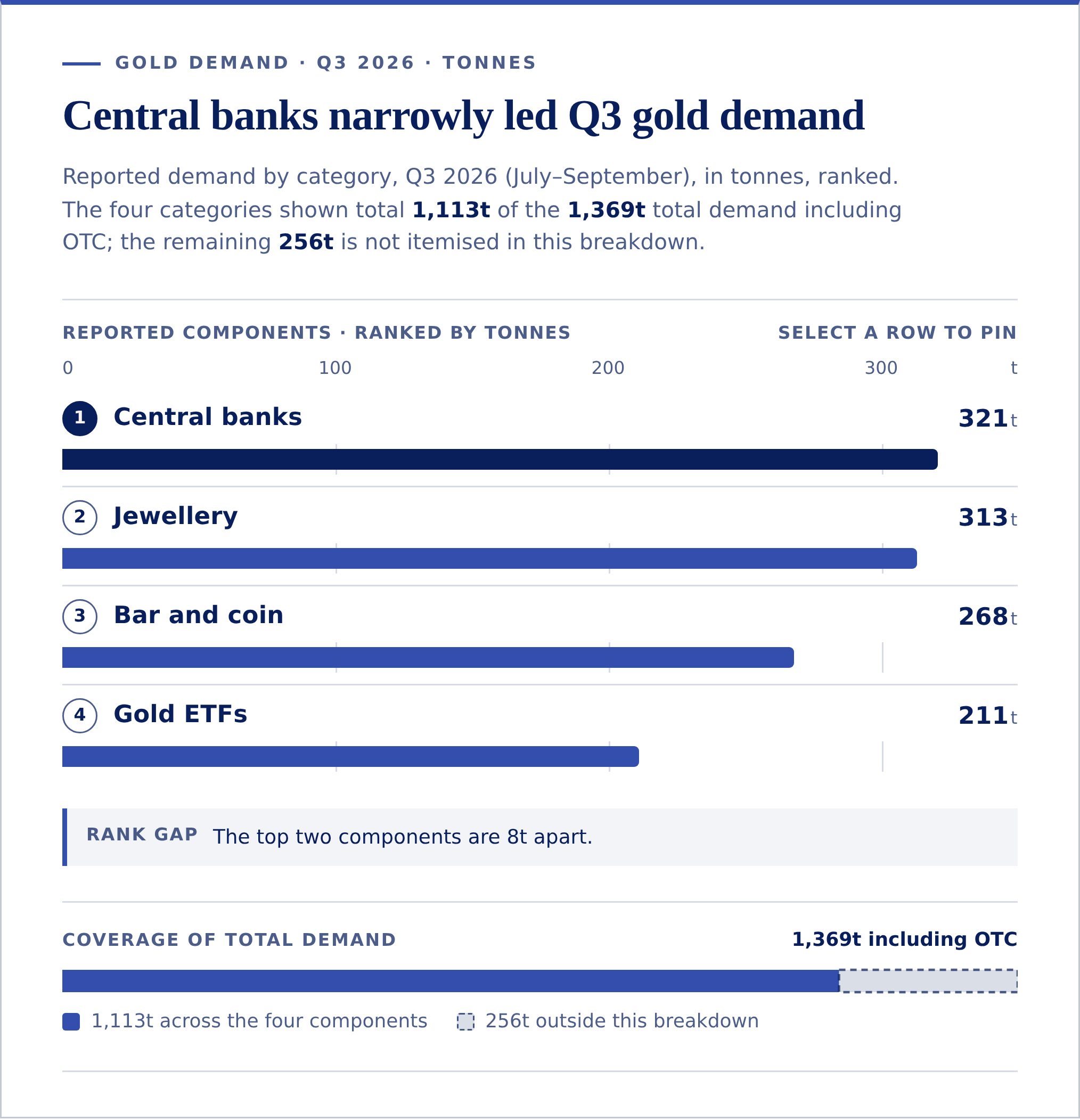
Buyers were present over longer periods. The World Gold Council reported 321 tonnes of central-bank purchases and 211 tonnes of gold ETF demand in the third quarter of 2026. Its reported total demand, including over-the-counter activity, was 1,369 tonnes; the individual categories shown in the report were a subset of that total, not a complete breakdown.
The next scheduled events identified in the Nov. 24 report were the Nov. 25 PCE inflation release and the Federal Reserve’s Dec. 8–9 meeting. Neither longer-term demand nor Monday’s rebound establishes which way gold will move over any particular 15-minute interval.