The Innovator Premium Income 15 Buffer ETF – July (LJUL) is scheduled to pay $0.1059 a share on Dec. 1, 2026, to shareholders of record on Nov. 27, its ex-dividend date. The fund estimates that 46% of the payment is a return of capital. The annualized distribution yield is 5.37% at a net asset value (NAV) of $23.65, but shareholders do not earn that yield on top of any S&P 500 gains.
LJUL does not own the stocks in the index. It holds U.S. Treasury bills and sells a put option on the SPDR S&P 500 ETF Trust (SPY). Treasury interest and the option premium fund the monthly payments. In exchange for the premium, LJUL takes on losses if SPY finishes its 12-month outcome period more than 15% below its starting price.
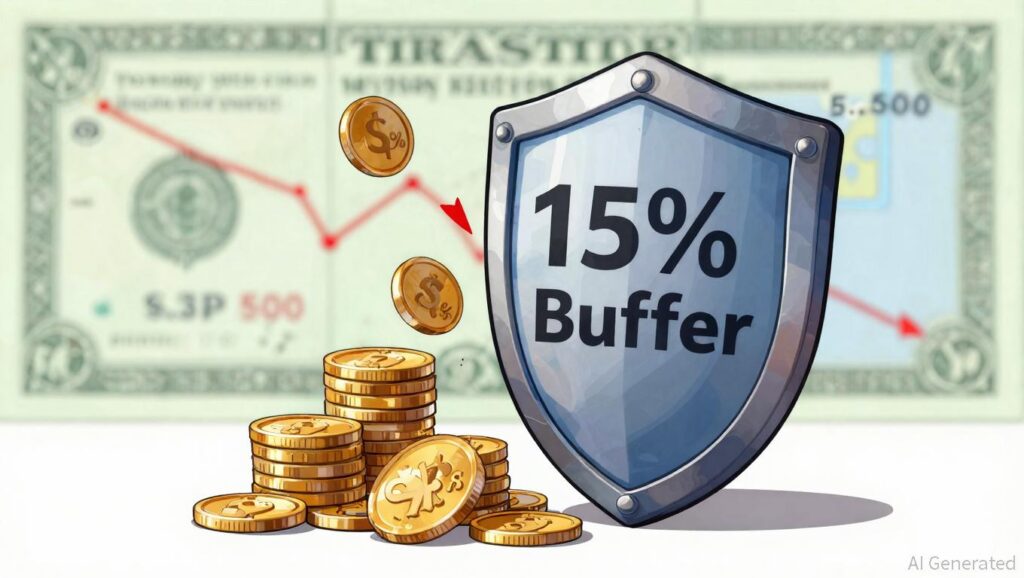
What the 15% buffer covers
On July 1, 2026, LJUL set its annual distribution rate at 6.13% of its starting NAV of $23.84, or 5.34% after its 0.79% expense ratio. The 5.34% rate and the 5.37% quoted yield describe the same stream of payments: the former uses the July 1 NAV, while the latter uses the lower November NAV. The prospectus calls the distribution rate “the maximum percentage return an investor can achieve” over the full outcome period.
The put option’s strike price is 15% below SPY’s July 1 price. If SPY ends the period on June 30, 2027, at or above that strike, LJUL is designed to finish near its starting NAV, leaving the distributions as the shareholder’s return. A 20% rally and a 10% decline would therefore produce the same target total return of about 5.3% for a full-period holder. Neither outcome is guaranteed.
Below the strike, LJUL bears additional losses one for one. A 20% decline would leave a loss of five percentage points beyond the buffer, cutting the designed total return to about 0.3% after distributions. A 30% decline would take it to about −9.7%. The buffer applies at the end of the period, not to the price a shareholder can get by selling earlier.
How much of the payment is income?
In its distribution notice, LJUL estimated that $0.0571 a share, or 54% of the Dec. 1 payment, was net investment income. It classified the other $0.0488, or 46%, as return of capital, compared with an estimated 41% of distributions for the year to date. The fund reported a 3.57% SEC 30-day yield, a measure of net investment income, distinct from its 5.37% distribution yield.
A return of capital reduces a shareholder’s tax cost basis rather than counting as current earnings. The notice is an estimate; the final classification appears on Form 1099-DIV. Nor is the dollar payment fixed indefinitely: it resets each July. The monthly amount was $0.11068 in the first outcome period, fell to $0.10347 in the second and rose to $0.10591 in the current period.
What changes for a November buyer
At the July reset, LJUL’s 5.34% net rate was 1.34 percentage points above the 4.00% yield on a one-year Treasury. By Nov. 27, SPY was down 4.03% from July 1, while LJUL’s share price was down about 0.8%. Including four distributions already paid, the fund’s total return was roughly 1%.
With 217 days left in the period, the fund’s calculator put the remaining buffer at 12.27%, not the original 15%. At $23.65 a share, it showed remaining potential distributions of $0.846, including the payment linked to the November record date. If SPY finished at or above the strike and LJUL returned to about $23.84, those payments plus the $0.19 recovery in NAV would amount to about 4.4% over the remaining period. That was a conditional return, not a promised yield.
The fund’s performance record shows the cost of forgoing a rally. From its June 30, 2024, inception through Oct. 31, 2026, LJUL reported an annualized NAV return of 5.65%, including distributions, against 15.03% for the S&P 500 price index, which excludes dividends. The December payment reflects that same trade: shareholders receive a defined monthly amount rather than equity gains, but remain exposed to declines beyond the buffer.