The U.S. Justice Department on November 23, 2026 filed a civil forfeiture complaint in Washington over USDC tied to the Binance cryptocurrency theft, describing the amount as more than $1.1 billion. The case asks a judge to turn an existing freeze into a court judgment. It does not move the blocked tokens, and it is not a completed recovery.
In a press release the same day, the department said the United States has assisted in “the freezing, seizing, and/or the return” of more than $2.9 billion in cryptocurrency since the Binance theft. The complaint is an attempt to convert one of those steps — seizure — into title. Forfeiture has been requested and has not been granted. No return process is named in the filing.
Freeze, restraint, and a requested forfeiture
Circle, the issuer of USDC, a dollar-pegged stablecoin backed by cash and Treasury bills, blocked the tokens on October 29, 2026, before any court order. A federal court granted a 14-day restraint in early November 2026. The November 23 complaint targets the USDC portion and asks a judge to make that restraint permanent.
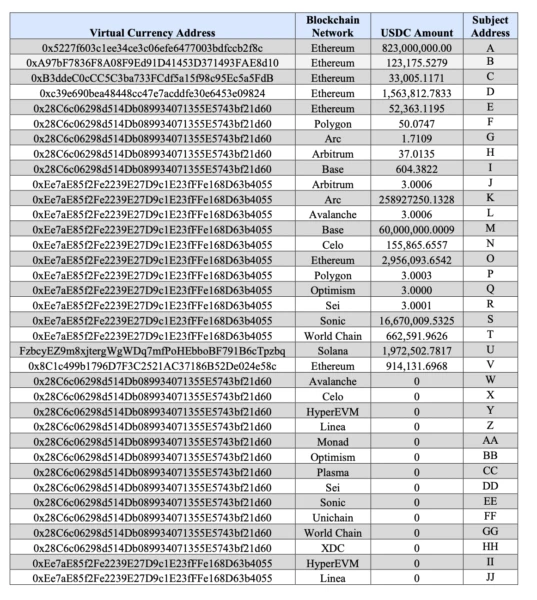
The tokens remain at 36 addresses across 18 blockchains, in wallets Circle says it cannot open. According to the complaint, Circle told prosecutors it has no technical ability to move USDC from the blocked addresses. Instead, Circle “has agreed to voluntarily issue new USDC in an amount equivalent to the amount of the Defendant Property” and transfer the new tokens to the United States once a judge signs a forfeiture order. The remedy described in the complaint is a mint of replacement USDC, not a transfer of the blocked coins.
Civil forfeiture is a lawsuit against property rather than a person. The government has to trace the USDC to a crime; it does not have to catch the hacker for this filing to proceed. That difference determines who is liable, who can be paid, and how the sum sits on the balance sheets of the companies in the middle.
One large address, and several totals
The complaint’s address table is highly concentrated. One Ethereum address accounts for $823 million, the largest line by far and the same figure Circle disclosed on the first day. The rest is a long tail across Ethereum, Polygon, Arc, Arbitrum, Base, Avalanche, Celo, Optimism, Sei, Sonic, World Chain, Solana, HyperEVM, Linea, Monad, Plasma, Unichain, and XDC.
Published totals differ. The Justice Department says “over $1.1 billion.” The Block, which reviewed the complaint, puts the listed balances at about $1.17 billion. crypto.news says about $1 billion. These are snapshots of a moving investigation rather than contradictions, and the $823 million Ethereum line is the anchor.
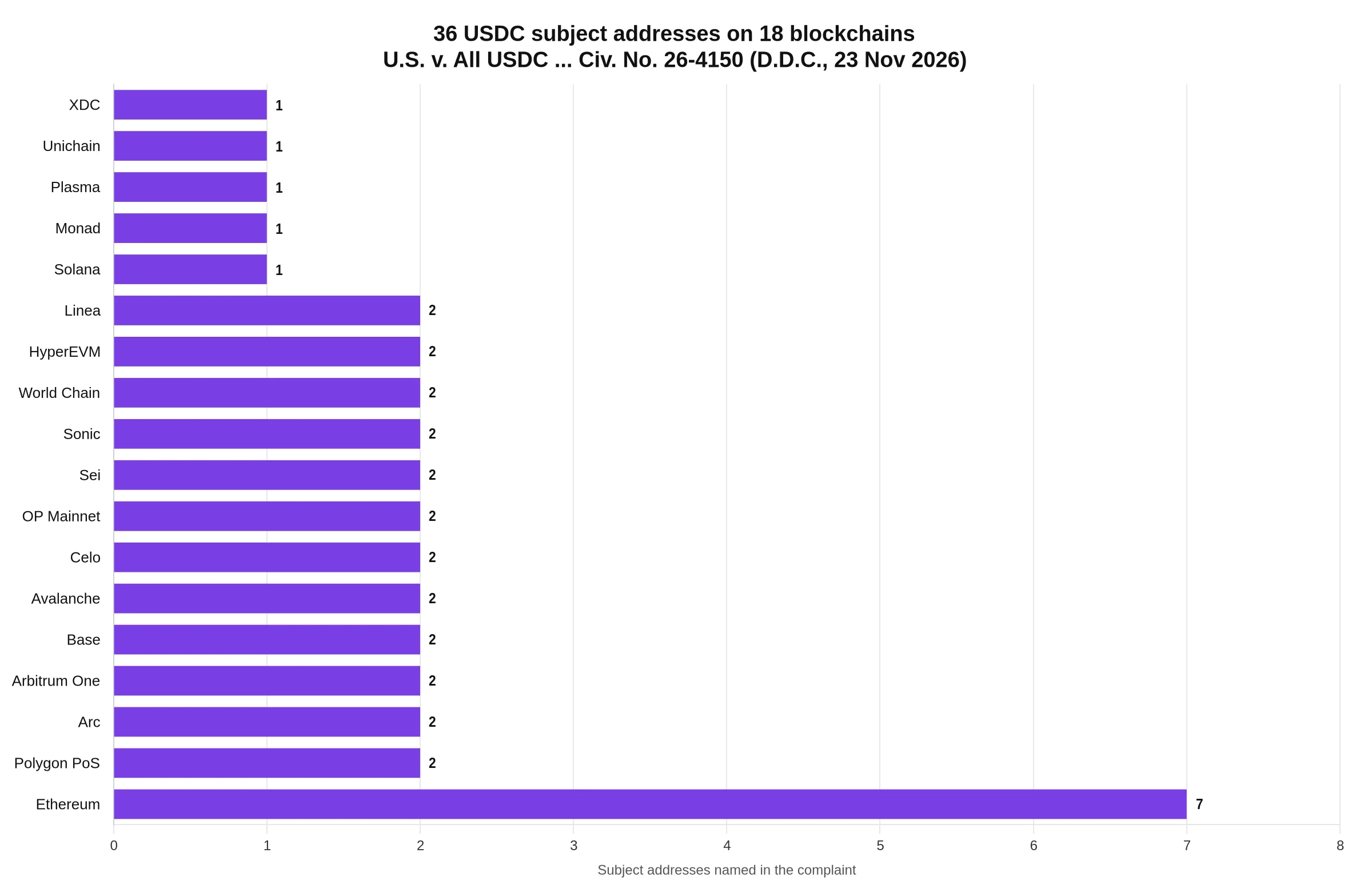
The addresses are unevenly spread. Ethereum has seven; a dozen chains have one or two each; five have one. That fragmentation is why the response required coordination across chains rather than a single switch.
What was frozen across the wider theft
Binance puts the loss at about $6.34 billion. Elliptic puts the haul at $6.43 billion. By November 20, 2026, $2.85 billion had been frozen or seized — 44% of Elliptic’s $6.43 billion total — while $2.35 billion was still in wallets linked to the hackers, and at least $247 million had passed through Bitcoin coinjoins. Those buckets were measured at different times and by different firms.
Elliptic’s comparison with an earlier case supplies the contrast. After the $1.5 billion Bybit hack in February 2025 — which Elliptic links to the same Lazarus group, and which was almost entirely ETH — about 3% was frozen. In the Binance case, the frozen or seized share was 44% of Elliptic’s total. The gap is attributed less to a change in policing than to asset type: stablecoins have an issuer that can blacklist an address, while ETH and BTC do not. Elliptic says about $786 million of stablecoins was converted before the freezes took effect.
Binance has already reimbursed customers
Binance did not wait for the courts. On November 12, 2026, it said it had replaced all $6.34 billion of affected customer assets using its SAFU user-protection fund, its futures insurance fund, and corporate treasury. It published a proof-of-reserves snapshot covering 198 tokens, presented as a public accounting meant to show customer balances backed at least 1:1. It plans to refill SAFU to about $1 billion. On Binance’s account, customers were made whole and the exchange absorbed the loss, which is why Binance is treated as the primary claimant.
The filing asks the U.S. Marshal to dispose of any forfeited funds “according to law.” Under the process Coinpedia describes, Binance would have 30 to 60 days after public notice to file a claim, and would then have to petition for remission — the department’s process for returning forfeited assets to victims. In that sequence, the United States would take title first. Binance describes the $2.85 billion as frozen or intercepted, and says not all of it has been returned.
Binance also has a parallel route: a $6.5 billion worldwide freezing order from Abu Dhabi’s ADGM courts, covering 26,000 addresses, with a December 1, 2026 hearing on whether 18 firms must hand over frozen assets. The U.S. case and the ADGM order can cover overlapping dollars. The filing says prosecutors were unaware of other claimants when they filed. The USDC portion is the most straightforward piece of the frozen pool because Circle is a U.S.-regulated issuer; the rest sits with other issuers and other jurisdictions.

Circle can blacklist, but says it cannot move the tokens
The freeze is a private contractual power, not a police power. Circle can blacklist an address; the complaint says it cannot take the tokens.
In a Wisconsin case, Circle told a court it could not invalidate or reissue about $381,000 of USDC held in a third-party wallet because it did not have the keys, and asked the court to dismiss a criminal contempt complaint. The same filing disclosed a general agreement with the Justice Department: after a final forfeiture order and a permanent blocklisting, Circle could voluntarily issue replacement USDC. The federal case follows that framework. The difference between an inability to move the coins and a willingness to mint replacements is a court order plus a negotiated agreement.
The accounting consequence is conditional. If the blocked tokens are not extinguished, replacement USDC is a second claim on the same reserves. Circle’s reserves — cash and short-term Treasuries — back USDC in circulation. Issuing about $1.1 billion of new tokens without releasing the reserves behind the old ones would leave about $2.2 billion of claims on about $1.1 billion of reserves. A forfeiture order may be able to treat the blocked tokens as legally extinguished even if the original entries remain on-chain, but Circle says it cannot perform the technical burn itself. Whether the order includes a permanent blocklisting, and whether Circle’s reserve attestations treat the old tokens as extinguished, is the difference between a recovery and a duplication.
Scale against USDC and listed-company prices
For Circle, the tranche is small relative to the float. USDC’s market value was about $69 billion on November 23, 2026, so the frozen amount is about 1.6% of that total. The blocked tokens remain outstanding until forfeiture, which means Circle still earns on the reserves behind them.
Circle’s third-quarter reserve income — interest earned on assets backing USDC — was $658 million, down 8% from a year earlier, even though average USDC in circulation rose 8%, because the reserve return rate fell 0.61 point to 3.5%. According to Ainvest data, Circle’s stock was $51.34, up 8% on November 23 but down about 36% over 20 days. Coinbase, which shares in Circle’s reserve income, traded at $108.78, down about 32% over 20 days. BitGo, the custodian, was at $3.91, down 28%. Binance is private; BNB, its exchange token, is the traded proxy. Ainvest’s crypto gauge read 11, described as extreme fear, on November 23. The filing did not change those cash flows. It changed the legal status of a balance that was already frozen.
A later legal duty, and an unresolved mint
The GENIUS Act’s freeze-and-seize requirements take effect on January 18, 2027. After that date, the power Circle used voluntarily becomes a legal duty for permitted payment-stablecoin issuers.
The $1.1 billion filing is a legal step, not the recovery itself. It would convert a freeze into a claim on a new Circle mint. If recovery follows, the funds would be new dollars routed through a U.S. court, with Binance as the claimant and the U.S. government taking title first. Assets with an issuer in the middle are the ones a government can reach; the bearer assets that could not be frozen remained outside that process.
If the court refuses the forfeiture, or if Circle cannot get comfortable that the blocked tokens are legally dead, the replacement USDC is not issued and the matter remains a restraining order. If the court grants forfeiture and Circle mints, the reserve attestation is where that legal treatment shows up as a balance-sheet fact.