JPMorgan expects companies to sell $450 billion of investment-grade bonds to fund artificial intelligence in 2027, up from $368 billion in 2026. The forecast, issued on Nov. 25 by strategists led by Tarek Hamid and Nathaniel Rosenbaum and reported by Bloomberg, comes as investors are demanding markedly different yields from borrowers with investment-grade ratings.
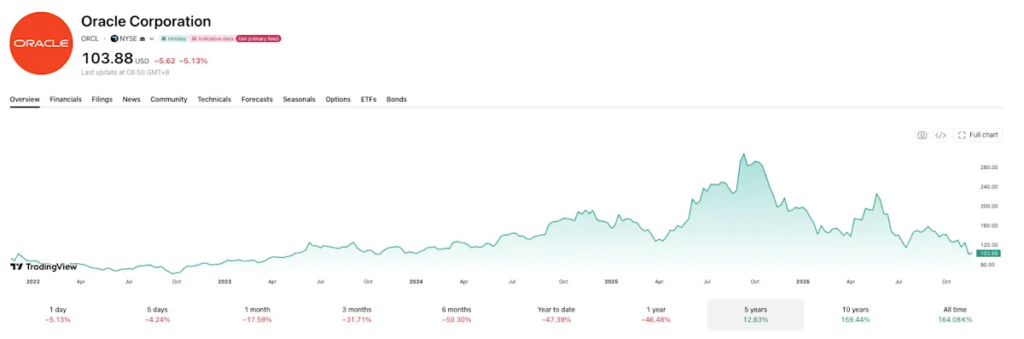
Oracle’s bonds yielded about 9% in the week of Nov. 25. A rough benchmark for the broader U.S. investment-grade market was 5.89%: on Nov. 24, the 10-year Treasury yielded 4.91%, and the ICE BofA US Corporate Index carried a spread of 0.98 percentage points, according to Federal Reserve data. That difference matters for companies financing data centers years before they expect the facilities to generate revenue.
What the financing forecasts count
JPMorgan’s $450 billion estimate covers public investment-grade bonds. The strategists also expect $65 billion in leveraged finance and $25 billion to $35 billion in securitized products. Goldman Sachs takes a different approach: its credit team, led by Amanda Lynam, projects about $985 billion of financing in 2027, comprising $440 billion of bonds from large cloud operators and $545 billion in project financing. The two banks’ bond estimates are close; project debt accounts for more than half of Goldman’s total.
The Federal Reserve’s November Financial Stability Report offers a different measure again. It says total AI infrastructure obligations, including undiscounted leases and guarantees, could exceed $3 trillion. That is a cumulative commitment, not the amount companies are expected to borrow in a single year.
Advanced computing already accounts for a substantial share of new borrowing. On Nov. 10, the Federal Reserve Bank of St. Louis reported that borrowing linked to advanced computing represented 31% of U.S. nonfinancial investment-grade corporate debt issuance, up from less than 6% three years earlier.

Why Oracle pays more
S&P cut Oracle to BBB−, its lowest investment-grade rating, on July 9. Moody’s affirmed its Baa2 rating on Nov. 2 but kept a negative outlook. Two days later, Oracle sold $10 billion of notes with coupons ranging from 7% to 8.65%, according to an SEC filing cited by BeInCrypto. It also sold $10 billion of stock. Its free cash flow was negative $23.7 billion in fiscal 2026.
Investors face a question of both timing and customer concentration. S&P estimates that OpenAI accounted for roughly half of the $638 billion order backlog Oracle reported in July. The contract begins in 2027. Oracle says the contract is fully funded and that it targets positive free cash flow in the second half of fiscal 2028. Some investors see sufficient compensation at recent prices: DoubleLine Capital’s Robert Cohen, who had warned of an AI debt bubble, became a buyer on Nov. 25, saying prices and yields reflected the risk.
Deal structure can also change the cost of credit. CoreWeave itself is rated below investment grade, but $4.5 billion of loans its bankers are preparing to sell are expected to receive investment-grade ratings. The loans are secured by graphics processors dedicated to Meta. In a bankruptcy, the structure gives lenders a claim on those chips and the associated Meta contract ahead of CoreWeave’s other creditors. The expected ratings apply to the loans, not to CoreWeave as a whole.
Interest comes due before the revenue is certain
JPMorgan expects AI capital spending to nearly double to $1.4 trillion in 2027 and then flatten in 2028. “Funding in 2027 is really for 2028,” the strategists wrote. At an illustrative borrowing cost of 6%, $450 billion of bonds would carry about $27 billion in annual interest. Actual costs will depend on the terms issuers secure.
In a separate analysis, JPMorgan Private Bank estimates that one gigawatt of AI data-center capacity costs about $40 billion to build. At 71% utilization, it would need roughly $11 billion of annual revenue to cover operating costs and the cost of capital. Applied to the 151 gigawatts the industry plans for 2027 through 2031, that implies an annual revenue requirement of roughly $1.7 trillion by the end of the period.
Large cloud operators have less cash relative to their assets than they once did. The St. Louis Fed found that their cash-to-assets ratio fell from 35% in 2018 to 16% in 2026, while their investment-to-assets ratio nearly doubled. Goldman’s credit team said the group collectively recorded negative free cash flow in the third quarter of 2026. For lenders, the size of the buildout is therefore only part of the calculation: the yield on each deal must also account for how long the borrower can service its debt before customers start paying for the new capacity.