Nvidia’s board unanimously voted on Monday to reinstate Jensen Huang as chief executive, less than a week after Chairman Harvey Jones said directors did not intend to bring him back. On the company’s third-quarter earnings call on Nov. 17, Jones said the board had accepted Huang’s resignation.
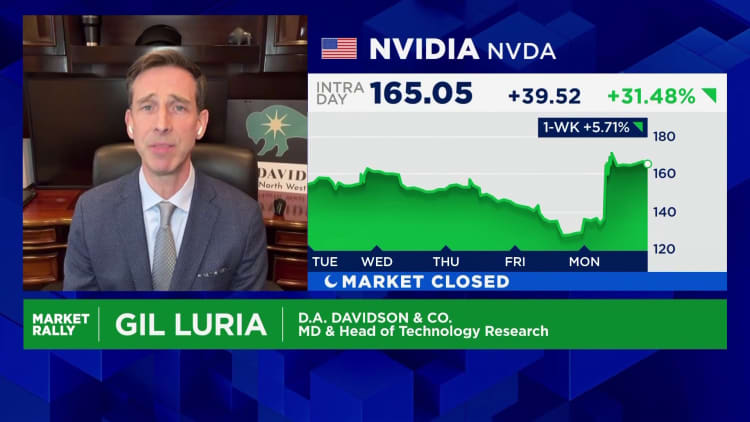
Nvidia shares rose as much as 36% during Monday’s session and closed 31% higher. The stock had closed at $125.53 on Friday even after strong third-quarter results. Organizers of a petition calling for Huang’s return said it had drawn more than 200,000 signatures.
The move coincided with a broader rally. The Nasdaq Composite gained 6.5% and the S&P 500 rose 4.7%, each posting its strongest session since April 2025.
The board said it acted after discussions with Huang and input from senior U.S. government officials, and that its investigation into his conduct would continue. Directors have not publicly detailed what they were told.
President Donald Trump said he had spoken with board members and that his administration provided assurances based on the information available to it. “The board decided to do what we wanted to do,” he told CNBC, adding that he believed his intervention had been important. “I’ve been speaking to the board directly and indirectly, and I felt very strongly about it,” he said. Semafor reported, citing people familiar with the matter, that Trump called into a board meeting to argue for Huang’s return.
Sen. Jack Reed, a member of the Senate Banking Committee, urged Treasury Secretary Scott Bessent and Commerce Secretary Howard Lutnick on Monday to appear before the committee. His statement cited reporting that Trump had been briefed by intelligence officials led by then-National Security Adviser Marco Rubio before intervening in support of Huang’s return. Reed has called on Huang to disclose his communications with Trump and on Nvidia to release a transcript of the board’s call with the president.
Rep. Gabe Amo, D-R.I., vice ranking member of the House Foreign Affairs Committee, said the reinstatement could widen congressional scrutiny rather than end it. “I think it frankly broadens the scope of the query,” Amo told CNBC. He said lawmakers should also examine administration officials involved in decisions affecting Nvidia and chip sales to China, and that he expects a planned closed-door interview with Huang on Dec. 1 to proceed. “He should start purchasing his plane tickets to Washington,” Amo said. “It is abundantly clear that this is ripe for questioning by Congress.”
Lawmakers are still seeking answers about the alleged smuggling of Nvidia products to China, possible diversion for military use, and possible advancement of Chinese AI capabilities. The Senate Banking Committee has scheduled Huang to testify on U.S. export controls on Dec. 3. House lawmakers have confirmed closed-door interviews with Huang on Dec. 1 and with Nvidia General Counsel Tim Teter on Dec. 2.
Reps. John Moolenaar, Rick Crawford and Brian Mast said in a joint statement that the board’s brief internal investigation and Huang’s reinstatement “do not erase the national security threats and questions that must be addressed.” The inquiry may also examine what Nvidia knew about the customers and resellers involved and what controls the company had in place. On Nov. 11, Sens. Elizabeth Warren and Chris Coons asked senior administration officials to retain records related to Nvidia exports of advanced AI chips to China and associated national security concerns.
Nvidia has said it will hire a chief compliance officer and establish a committee overseeing national security and export controls. Josh Gilbert, eToro’s lead analyst for APAC and the Middle East, said investors will watch whether those safeguards have meaningful authority.
Succession remains unresolved. Gil Luria, head of technology research at D.A. Davidson, said Nvidia has a limited window to prepare for a future president who may be less supportive of Huang. With Trump’s term ending in two years, Luria argued the company needs a clearer plan for who could take over if Huang were forced to leave again.
Gilbert cited Nvidia’s roughly 75% revenue-growth forecast for the next financial year as a sign of strong near-term demand, while questioning whether customer orders and AI investment can sustain that pace. Luria said concerns about the broader AI trade persist, including data-center financing costs, potential overbuilding by neocloud companies, and obstacles to new facilities. Bernstein analyst Stacy Rasgon said doubts about whether AI spending is achievable and sustainable were not caused solely by Huang’s departure. UBS noted Nvidia’s roughly $390 billion in supply commitments and the need to keep demand moving through its ecosystem.
Gilbert said part of Monday’s rally reflected a recovery of earlier losses rather than new growth assumptions. Bernstein restored its “Outperform” rating and kept a $200 price target; UBS maintained a $220 target. “For the share price, it comes down to whether Nvidia can keep delivering as it has done over recent years,” Gilbert said, adding that Huang’s return could ease worries about the period beyond next year “because he’s the one who sits down with the biggest customers and gets those multi-year orders over the line.”